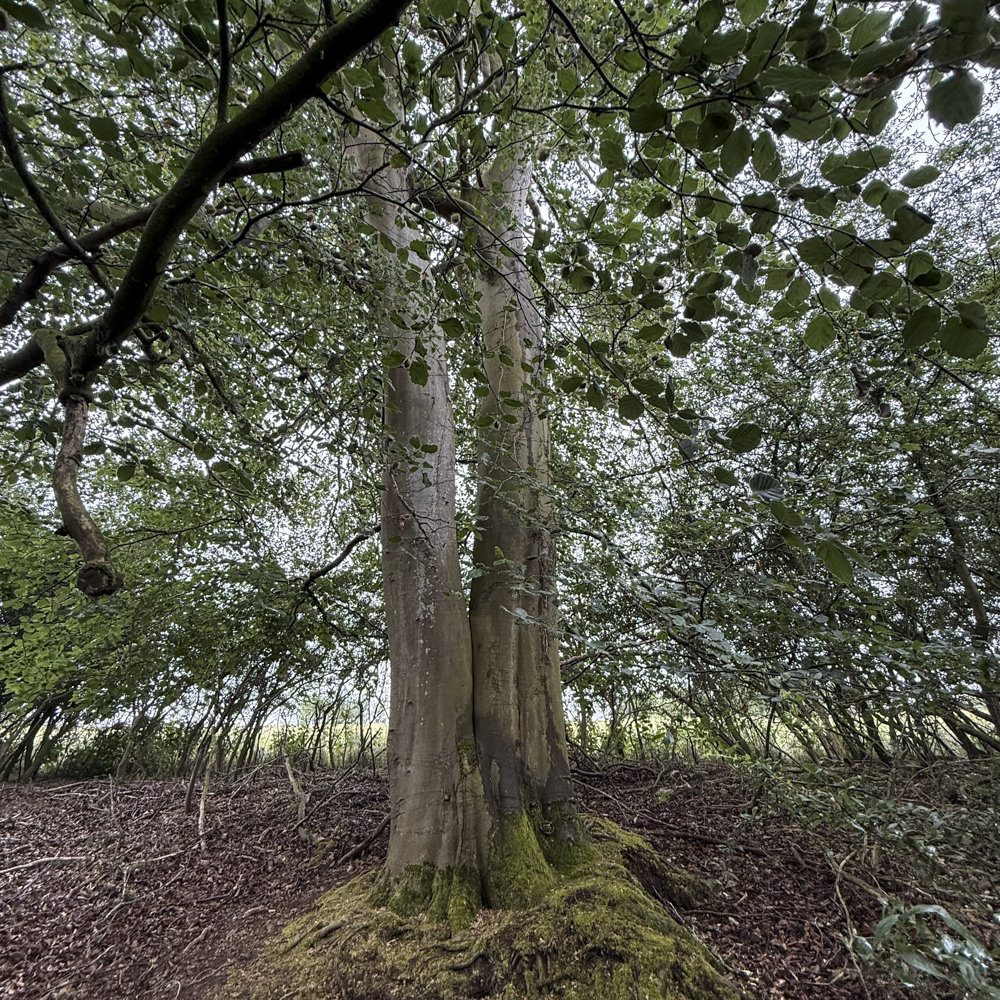
This is a polyembryonic beech in Wrongs Covert (Norfolk), next to a Saxon stretch of the pilgrim’s way from Norwich to Walsingham. The two trunks are identical twins, growing from a single seed that split into two embryos. The twin on the right has grown a branch, high up in the canopy, like an arm, which is preventing the twin on the left from leaning any further and falling.
Wrongs Covert, about 10 miles outside Norwich is a heritage and education centre teaching natural heritage and woodland crafts, nestled in a fragment of ancient woodland traversed by a former glacial stream.
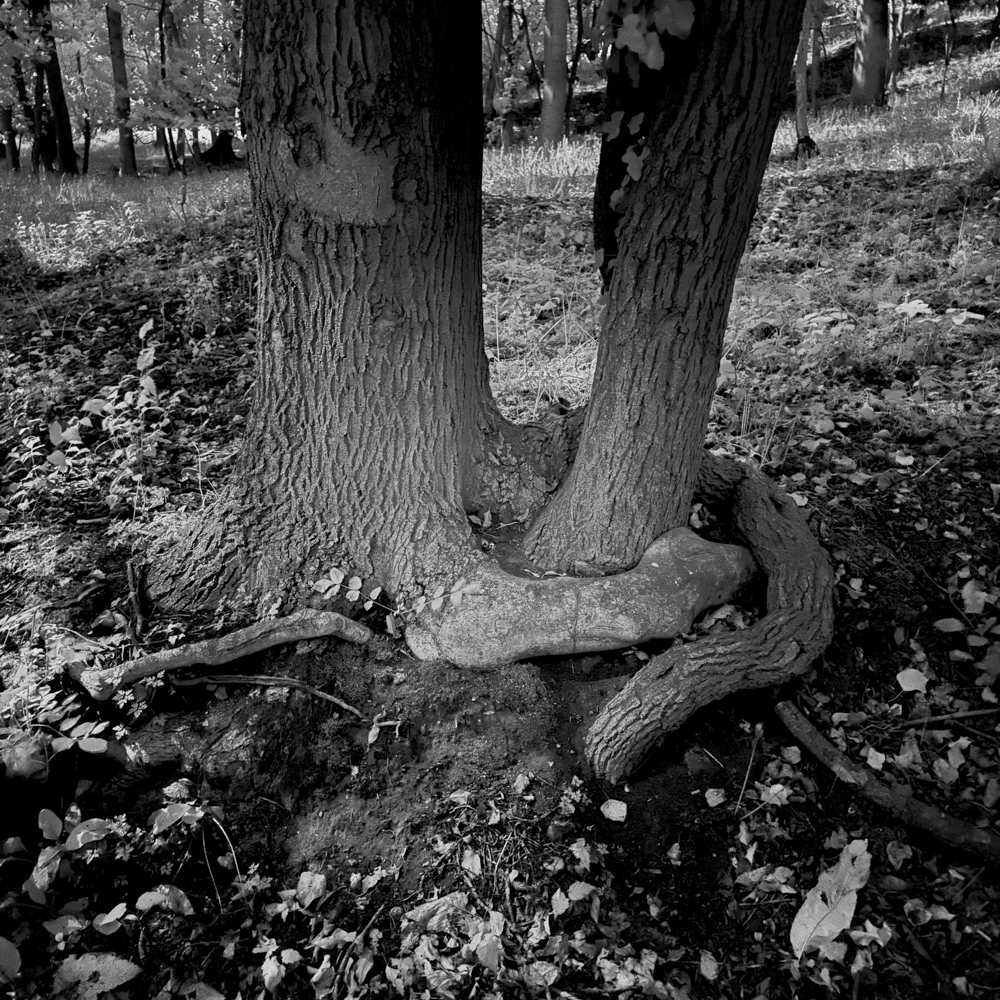
Further along the Walsingham Way – still in the Wensum valley, just north of Ringland – the tree on the left, possibly also a split-seed tree, appears to be supporting it weaker neighbour with a pair of maternal arms around it.
In her book Finding the Mother Tree Forest ecologist Suzanne Simard has famously researched what she calls the ‘Mother Tree’ in forests in Canada. A lifetime’s study eventually spawned the idea of the Wood Wide Web of fungal (mycorrhizal) connections between trees, along which pass information, nutrients and signals.
Mother of leaves and sweetness
In her bittersweet poem Winter Trees, written in the last year of her life and published posthumously by her husband, the poet Ted Hughes, Sylvia Plath also sees the tree as mother. Although many species are hermaphrodite or ‘monoecious‘, several, including the ash, holly, poplar, willow, and yew, are dioecious– they have separate male and female trees.
Here, Plath portrays trees as keepers of stories and history – memories growing ring on ring – and also as blessed with the gift of giving birth to them effortlessly: mother of leaves and sweetness. This is in contrast with Plath’s own ambivalence about birth and motherhood:
Winter Trees by Sylvia Plath
The wet dawn inks are doing their blue dissolve. On their blotter of fog the trees Seem a botanical drawing. Memories growing, ring on ring, A series of weddings.
Knowing neither abortions nor bitchery, Truer than women, They seed so effortlessly! Tasting the winds, that are footless, Waist-deep in history.
Full of wings, otherworldliness. In this, they are Ledas. O mother of leaves and sweetness Who are these pietas? The shadows of ringdoves chanting, but chasing nothing.
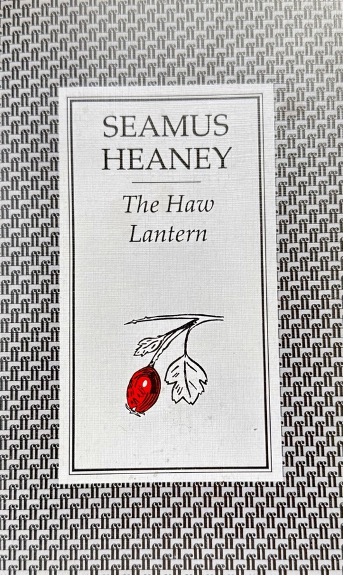
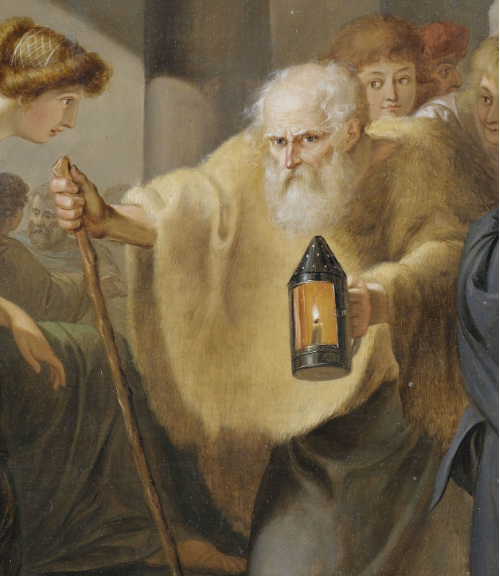
This is another reflection triggered by a charity bookshop find – this time of a first edition (1987) collection of poems by Seamus Heaney. In the poem that gave the collection its title – The Haw Lantern[1] – Heaney likens the red berry of the Hawthorn, (Haw – Cretaegus monogyna) drooping on its stalk, to the lantern held by Diogenes, the ascetic philosopher of ancient Greece,[2] who wandered the streets – in daylight – seeking ‘a [wise] man’[3]
It is a minutely observed poem, with at least one tightly packed aside that could almost be overlooked: ‘Its blood-prick that you wish would test and clear you.’ As I enter my senior years and have to keep blood sugar levels under control, that haw-like blood-prick is a daily encounter. And those increasingly frequent visits to the phlebotomist to be bled for this or that test leave me, too, waiting for the all-clear. I wonder whom Heaney had in mind, and for which test, as he was still a youthful 48-year-old at the time. But I digress…
Enter the tarot
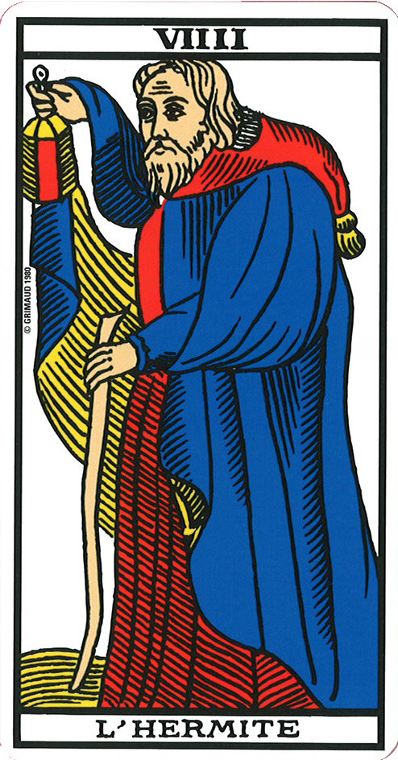
Reading Heaney’s poem, the tarot card, L’Hermite, numbered VIIII in the series of 22 (or should I write XXII) major arcana, came to mind. Here, too, is a cloaked, bearded elder, holding a lantern in one hand and a walking stick in the other. Is he seeking truth, like Diogenes? Or is he already enlightened, a beacon showing others the way?
Soon after I moved to Paris in 1986, where I lived for the next 20 years, I stumbled across a weekly improvised lecture-cum-performance by the Chilean cinematographer-mystic tarot-maestro Alejandro Jodorowsky at the Maison des Mines, on the southern fringe of the Latin Quarter. An odd venue, but one that was large enough to hold the 200+ people who would regularly turn up – and cheap enough, as the conférences were free. Someone with a bucket would collect donations, “to pay for a meal”, as the audience filed out.
‘Jodo’ as he was known, would take centre stage, often dressed in purple, flanked by human-scale tarot cards, and would free-associate on a theme, usually linked to the family tree – l‘arbre généalogique. He was (is – he turned 97 in February) convinced that most psychological issues are transgenerational and often linked to what he has called a ‘misreading of sacred texts’.
One or two people from the audience would join him on stage and provide live material for a spontaneous bout of public psycho-magical analysis. Subjects regularly included sibling rivalry, couple problems, financial struggles, stymied creativity…
I became a regular attendee for a while and even spent a few weekends at his extraordinary ‘psycho-magical’ self-inquiry group sessions at a private house in Fontenay-sous-Bois in the eastern suburbs.
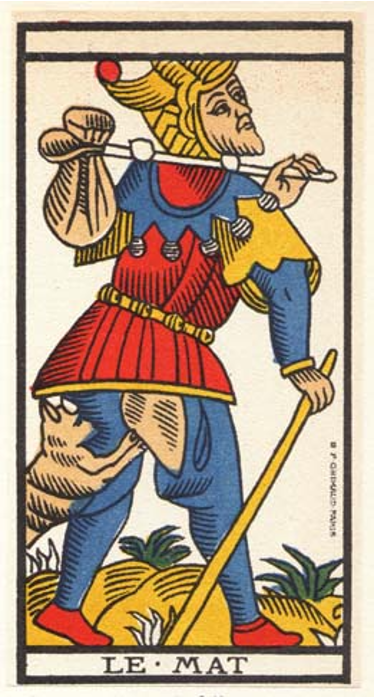
Now, while Jodorowsky spent countless hours interpreting the tarot and holding free consultations in cafés, I don’t believe he dwelt on the links between L’Hermite and Diogenes. He is more concerned with the internal logic of Grimaud’s Tarot de Marseille, its imagery, symbolism and, not least, its coherence as a series, with time passing left-to-right, 1 to 22.
So, for Jodorowsky, L’Hermite (VIIII) might be contrasted with the very first major arcanum (is that the right term?), Le Mat, which has no number. LeMat shows a bearded young man, just starting out in his adult life, with everything before him. In contrast, L’Hermite is looking back, with furrowed brow and a stick crooked with age.
The next arcanum, number X, is La Roue de Fortune, revolving anti-clockwise – a new cycle of trials eventually culminating in XX Le Jugement and the final card, Le Monde, a kind of epiphany or triumph, with the symbols of the evangelists – angel (Matthew), lion (Mark), ox (Luke), and eagle (John) – in the four corners.
Back to Heaney
Heaney, unlike W B Yeats, did not delve much into mysticism or the occult, being more rooted in the imagery of the Irish countryside, Celtic mythology and, of course, the Classics. So, for Heaney it was eyeballing – or rather being eyeballed by – the common haw that evoked Diogenes and the search for truth. However, the haw lantern is a ‘small light for small people’, not there ‘to blind them with illumination’, but simply to remind them ‘to keep the wick of self-respect from dying out’.
When I found The Haw Lantern back in April, it was the paradoxically white blossom of the blackthorn that lit the paths on the daily moonlit walks I made on a silent retreat near Bath, looking inwards for a glimpse of truth. Seeking it neither in the ‘used to be’ of the past, nor the ‘could be’ of the future. So, where is the present moment in the tarot cycle(s)? I think Italo Calvino had a go at answering that in The Castle of Crossed Destinies, but that’s another story
Epilogue
It is now the month of May, another common name for the haw, whose rather fetid-smelling flowers and edible ‘bread-and-cheese’ leaves were so much a part of the hedgerows around my childhood home in the Chilterns.