
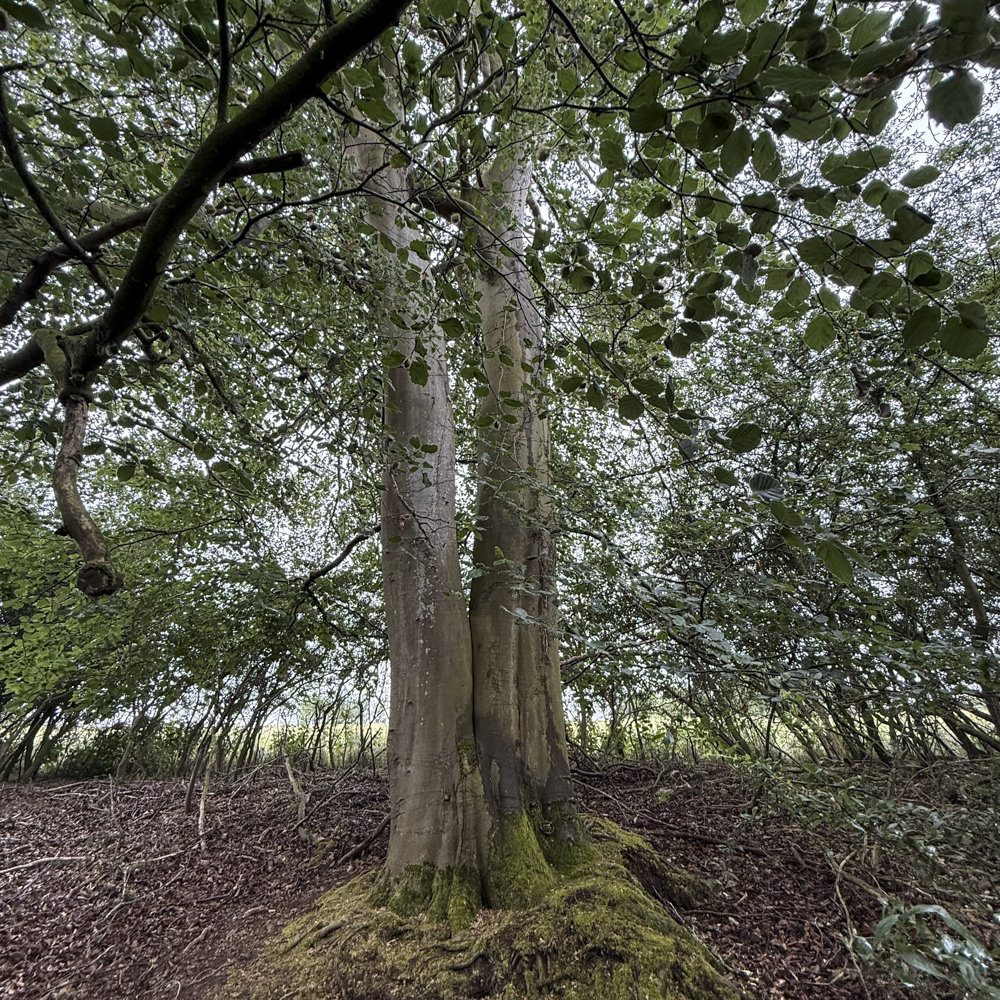
This is a polyembryonic beech in Wrongs Covert (Norfolk), next to a Saxon stretch of the pilgrim’s way from Norwich to Walsingham. The two trunks are identical twins, growing from a single seed that split into two embryos. The twin on the right has grown a branch, high up in the canopy, like an arm, which is preventing the twin on the left from leaning any further and falling.
Wrongs Covert, about 10 miles outside Norwich is a heritage and education centre teaching natural heritage and woodland crafts, nestled in a fragment of ancient woodland traversed by a former glacial stream.
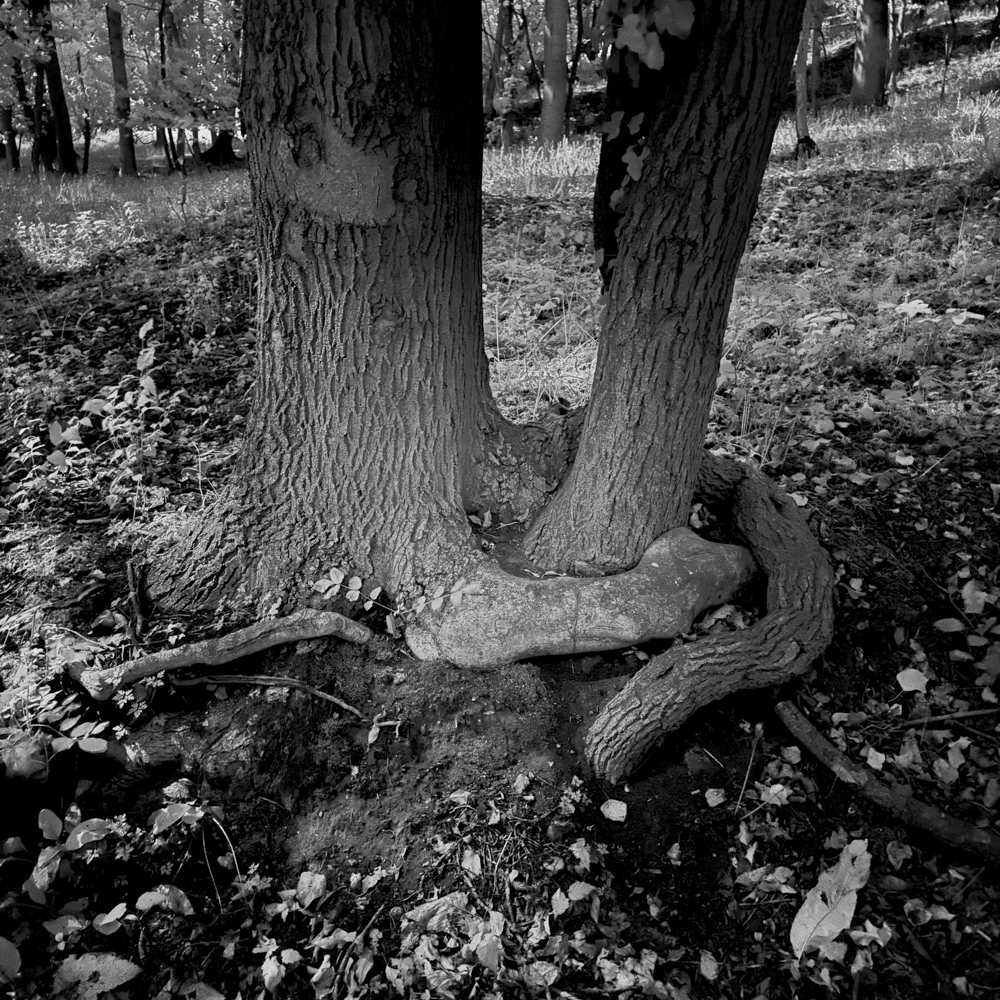
Further along the Walsingham Way – still in the Wensum valley, just north of Ringland – the tree on the left, possibly also a split-seed tree, appears to be supporting it weaker neighbour with a pair of maternal arms around it.
In her book Finding the Mother Tree Forest ecologist Suzanne Simard has famously researched what she calls the ‘Mother Tree’ in forests in Canada. A lifetime’s study eventually spawned the idea of the Wood Wide Web of fungal (mycorrhizal) connections between trees, along which pass information, nutrients and signals.
Mother of leaves and sweetness
In her bittersweet poem Winter Trees, written in the last year of her life and published posthumously by her husband, the poet Ted Hughes, Sylvia Plath also sees the tree as mother. Although many species are hermaphrodite or ‘monoecious‘, several, including the ash, holly, poplar, willow, and yew, are dioecious– they have separate male and female trees.
Here, Plath portrays trees as keepers of stories and history – memories growing ring on ring – and also as blessed with the gift of giving birth to them effortlessly: mother of leaves and sweetness. This is in contrast with Plath’s own ambivalence about birth and motherhood:
Winter Trees
by Sylvia Plath
The wet dawn inks are doing their blue dissolve.
On their blotter of fog the trees
Seem a botanical drawing.
Memories growing, ring on ring,
A series of weddings.
Knowing neither abortions nor bitchery,
Truer than women,
They seed so effortlessly!
Tasting the winds, that are footless,
Waist-deep in history.
Full of wings, otherworldliness.
In this, they are Ledas.
O mother of leaves and sweetness
Who are these pietas?
The shadows of ringdoves chanting, but chasing nothing.

