Hornbeam

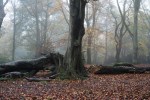
Old Hornbeam coppice, Highgate Wood
Old Hornbeam coppice, Highgate Wood – this is one tree, the ‘trunks’ growing from a now buried stump

Hornbeam, Carpinus betulus, also known as iron wood, or yoke elm because the wood is so hard it can’t be worked easily. It was mainly used for ox yokes, cogs and cartwheels. The grown-out coppice stools like this one in Highgate wood would also have been used for firewood or charcoal, as it burns slowly and brightly ‘like a candle’.  It was used for the tall, dense hedges of the original maze in Hampton Court, although these have since been replaced.

The poet John Clare was fond of hornbeam, which is one of the principal trees in Epping Forest, where he spent four years in the High Beach asylum, from 1837-1841, suffering from severe depression. He was allowed considerable freedom to walk in the forest and, indeed, in July 1841  walked out of the asylum and followed the Great York Road  until he reached his home in Northborough, 80 miles away, four days later. That year, while at High Beach, he wrote  Child Harold, mentioning the hornbeam:

How beautiful this hill of fern swells on.
So beautiful the chapel peeps between
The hornbeams with its simple bell – alone
I wander here, hid in a palace green.

20130805-_1040383_hornbeam_small

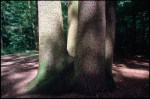
Seeing the hornbeams, I was reminded of a three-trunked hornbeam in the Bois de Vincennes, just east of Paris, in whose shade for seven years, every Saturday morning, I learned tai chi with my friend and teacher Li Gui Sheng and fellow student and friend Claude.

9911-2-06

Every Saturday that is, until, in a few hours after midnight on 26 December 1999, a hurricane blew down the forest. Miraculously ‘our’ tree was spared, though it took us several hours to find it amid the tangled mess of fallen trunks. About a year later we cleared a space beneath the tree again, now sporting a mass of side shoots from its trunk in an all-out fight for survival. But it wasn’t the same. The squirrels had gone, replaced by pheasants, now the forest was more like heathland or scrub. And the dog walker who had shouted after “Whisky” and “Frisky”, as we fought invisible opponents in slow motion, had found another route.

0504cercledenergie

They’re back!

“Look! They’re back! Look!” wrote Ted Hughes in his poem “Swifts”. It was a 15 May.  While “walking the dog” over the past years, I’ve been noting when the swifts return from Africa to the streets around where I  live, in northwest London. And how many there are. It was, with surprising synchrony, on 15 May that I first heard them screeching overhead this year. And, even three weeks later, there are still just four of them. There were nine last year. Seventeen the year before. Which end of their migration is to blame? Disappearing nesting sites, here? Insecticides in Africa?
And, the elms he mentions are long gone, too, apart from a few in Brighton and here and there.  Maybe, one day, we’ll be able to say “Look! They’re back!” about them, too.

Swifts

by Ted Hughes

Fifteenth of May. Cherry blossom. The swifts
Materialise at the tip of a long scream
Of needle. ‘Look! They’re back! Look!’ And they’re gone
On a steep

Controlled scream of skid
Round the house-end and away under the cherries. Gone.
Suddenly flickering in sky summit, three or four together,
Gnat-whisp frail, and hover-searching, and listening

For air-chills – are they too early? With a bowing
Power-thrust to left, then to right, then a flicker they
Tilt into a slide, a tremble for balance,
Then a lashing down disappearance

Behind elms.
They’ve made it again,
Which means the globe’s still working, the Creation’s
Still waking refreshed, our summer’s
Still all to come —
And here they are, here they are again
Erupting across yard stones
Shrapnel-scatter terror. Frog-gapers,
Speedway goggles, international mobsters —

A bolas of three or four wire screams
Jockeying across each other
On their switchback wheel of death.
They swat past, hard-fletched

Veer on the hard air, toss up over the roof,
And are gone again. Their mole-dark labouring,
Their lunatic limber scramming frenzy
And their whirling blades

Sparkle out into blue —
Not ours any more.
Rats ransacked their nests so now they shun us.
Round luckier houses now
They crowd their evening dirt-track meetings,

Racing their discords, screaming as if speed-burned,
Head-height, clipping the doorway
With their leaden velocity and their butterfly lightness,
Their too much power, their arrow-thwack into the eaves.

Every year a first-fling, nearly flying
Misfit flopped in our yard,
Groggily somersaulting to get airborne.
He bat-crawled on his tiny useless feet, tangling his flails

Like a broken toy, and shrieking thinly
Till I tossed him up — then suddenly he flowed away under
His bowed shoulders of enormous swimming power,
Slid away along levels wobbling

On the fine wire they have reduced life to,
And crashed among the raspberries.
Then followed fiery hospital hours
In a kitchen. The moustached goblin savage

Nested in a scarf. The bright blank
Blind, like an angel, to my meat-crumbs and flies.
Then eyelids resting.
Wasted clingers curled.
The inevitable balsa death.
Finally burial
For the husk
Of my little Apollo —

The charred scream
Folded in its huge power.

Trees

Human / Nature

Meditations on the relationships between humans and the rest of the natural world

(read more here)